Free exhibit about the demolition and construction of Toronto’s downtown in the 1960s, 70s & 80s
After a ‘what did you do today?’ swapping of stories, my son asked me, ‘why didn’t you study history in university?’
I had just finished telling him about my excursion to the City of Toronto Archives and the interesting things I learned about Toronto.
His question about my university major surprised me. Why didn’t I study history?
I don’t particularly remember studying it in school, other than memories of field trips to the Motherwell Homestead National Historic Site (pioneer farmhouse in Saskatchewan; a smaller version of Black Creek Village in Toronto.)
For me, history came to life after high school when I went to Europe: cobblestone streets, medieval cities and roman ruins. Fascinating, as the oldest buildings in my hometown were constructed in 1915. Later in university came a deep dive into Canadian history when I worked as a parliamentary tour guide; then exploring cultures from around the world working at the Royal Ontario Museum.
While some people get the travel bug, I think I caught the history bug. Now, most of my travels – international or on the streets of T.O. – often include museum visits and stopping to read the historic plaques, much to the eye-rolling of my kids in TOw.
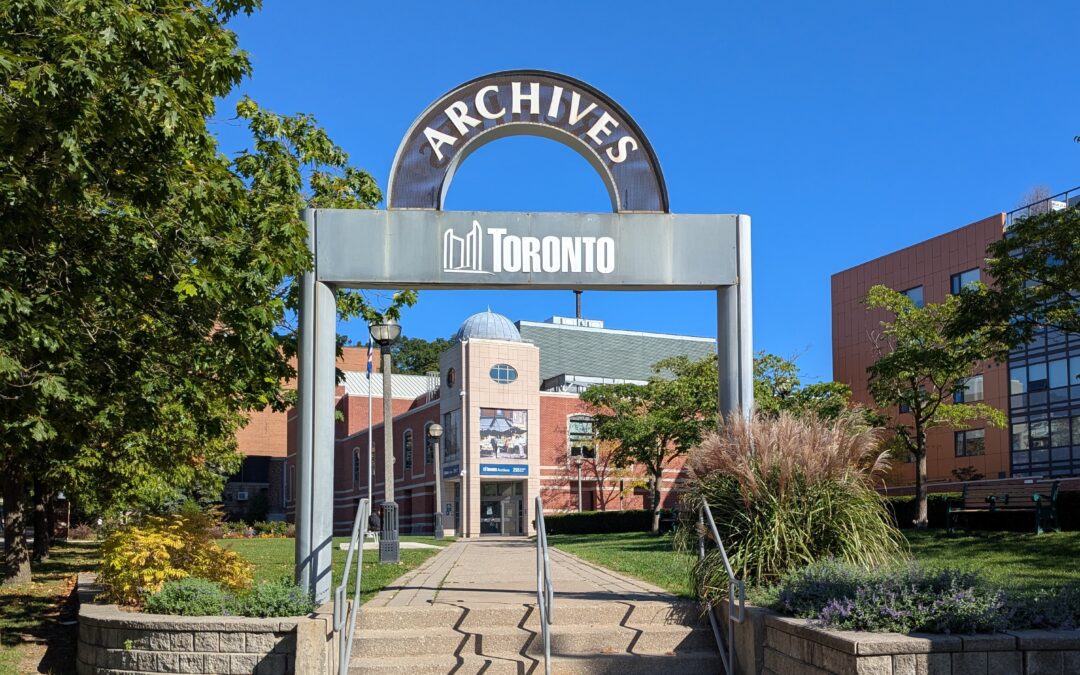
This time I went kid-free to the City of Toronto Archives.
About the Archives
The building itself at 255 Spadina Rd isn’t remarkable. Opened in 1992, it houses an airy and bright atrium, a lecture room and research hall. Behind the sciences, its climate-controlled 11,000-sq-ft storage area holds 130,000 boxes of records, containing historical municipal records from pre- and post-amalgamation in 1998. There are photographs, maps, plans and architectural drawings, including the oldest map of the Toronto Harbour seating to 1792.
What drew me to the Archives this time was its current exhibit Under the Wrecking Ball: Shaping Toronto’s downtown 1960-1989.
About the exhibit
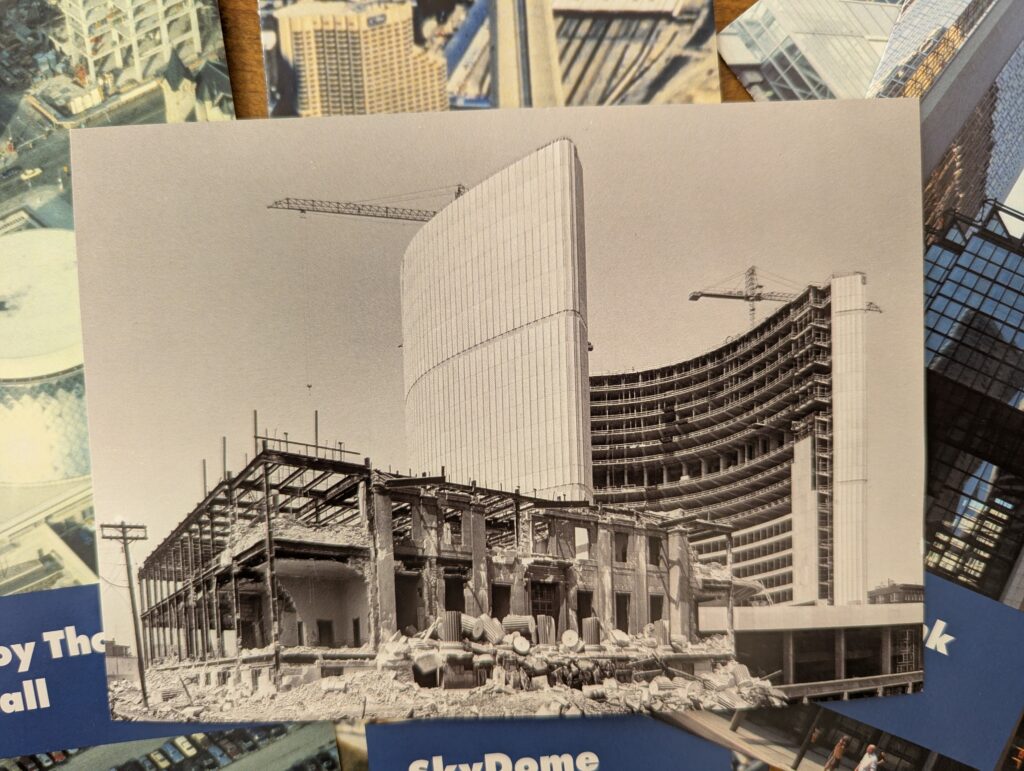
The free exhibit on display in the main floor lobby features photography and some historic artifacts from ten iconic downtown projects that changed the face of Toronto’s core. These massive redevelopments, such as First Canadian Place, Eaton Centre and SkyDome – represented a time of prosperity and modernity. In with the new meant the demolition of many older city blocks and buildings. Some of the most drastic that the kids in TOw would recognize is the construction of the new City Hall in 1964 that saw the removal of the Registry Office.
Recommended for:
Tweens, teens and their parents in TOw will find the stories and photography interesting, depending on the kid and how much their parents engage with them and how it relates to the city they know. Some little kids in TOw may also enjoy looking at the black & white photography of old streetscapes, cars and people.
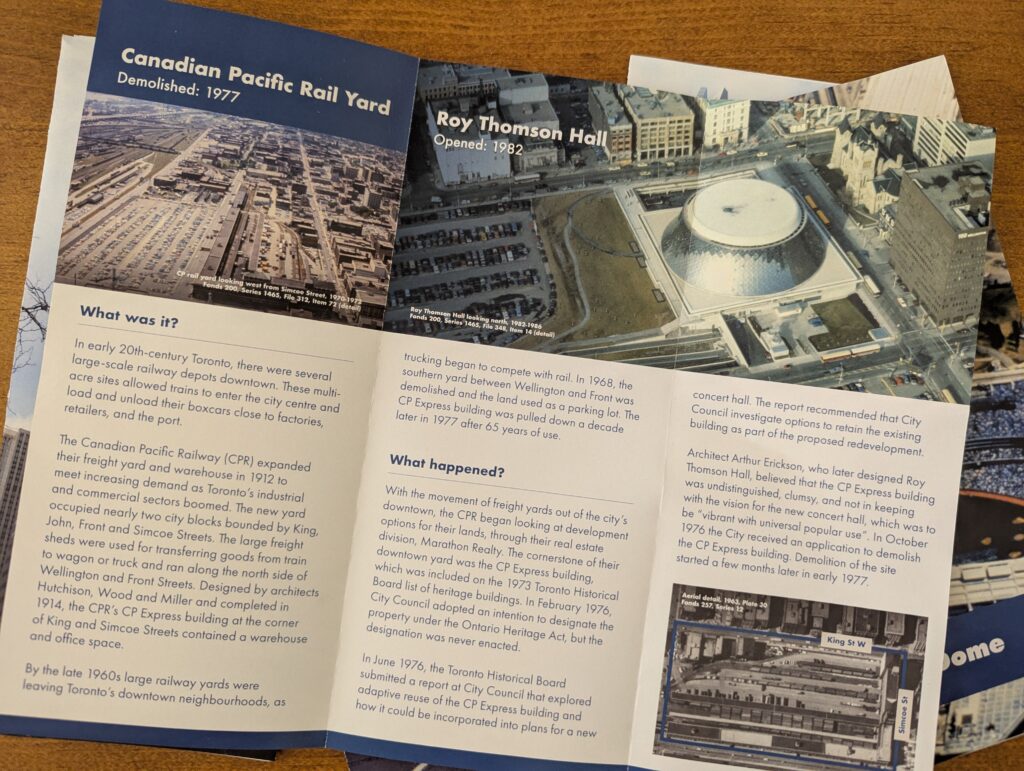
The construction of the SkyDome, in particular, should resonate with all. The SkyDome, built in 1989, replaced an old roundhouse, a central hub used for train repair. There are some artifacts that were dug up at the site and on display in the exhibit.
For the history nerd in TOw, you’ll surely pick up all ten pamphlets to learn more and appreciate the history around how and when historic buildings were identified and subsequently protected.
Don’t miss:
While you’re there, have a peek at the exhibit about the history of the TTC tickets and tokens. You can also pop up to the 2nd floor research hall. However, if you’ve got a specific subject to look up, best to do some prep work in advance at home. The Archives has tons of information readily available online (more than 1.25 million photographs and 10,000-plus maps and plans.) You can quite easily dive deep into a rabbit hole. Once you resurface and need to see some materials in real life, best to book an appointment (material request must be sent in 24 hours in advance.)
Trip tips:
Getting there: The City of Toronto Archives is located at 255 Spadina Road, closest intersection is Spadina Rd just north of Dupont. There is a parking lot, street and paid parking. On TCC, closest subway stop is Dupont.
The low-down: Free to visit. Open Monday to Friday 9 a.m. to 4 p.m. (Research Hall is closed from noon to 1 p.m.) The Archives offers free education programs for elementary, high school and post-secondary classes. There was a group of elementary school kids in TOw while we were there and the were fully engaged.
In the hood: There are few playgrounds in walking distance. Jean Sibelius Square (with a great climbing wall for the kids) is a five-minute walk south of Dupont along Brunswick Ave. Vermont Square Park (there’s a pirate ship climbing structure) is a 12-minute walk west of Bathurst and south of Dupont. Casa Loma is a 15-min walk north along Spadina. Closest independent coffee shop is Typist Studios & Coffee is on Dupont and Spadina.
What’s next: Looking up the history of our house!
Recent Comments